
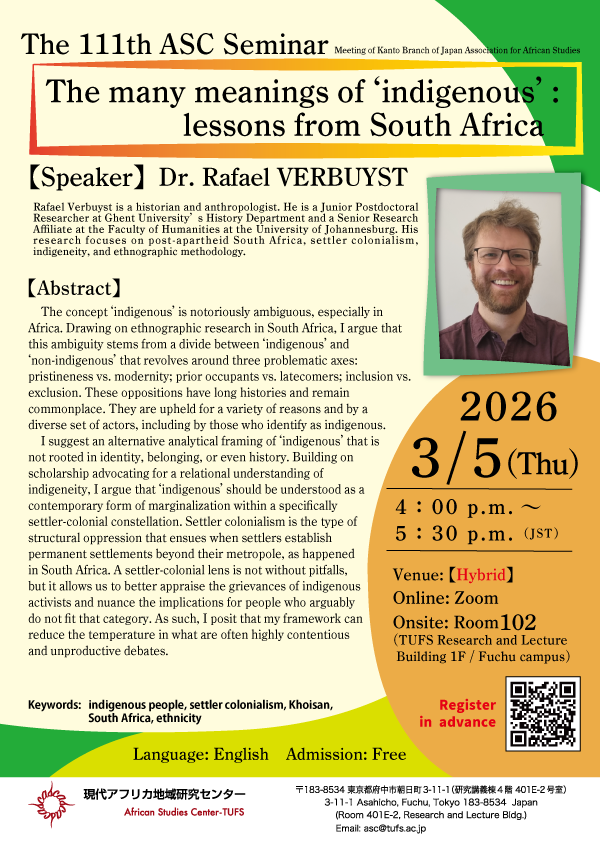
The 111th ASC Seminar will feature a talk by Dr. Rafael VERBUYST on "The many meanings of 'indigenous': lessons from South Africa"
The seminar will be held in a hybrid format, allowing participation via Zoom as well. Please be sure to register in advance. If you are nearby, we warmly encourage you to register in advance and join us.
Please note that this seminar will start earlier than the usual ASC seminar time (from 4:00 PM).
??Date&Time: March 5, 2026 (Thu) 4:00p.m. - 5:30p.m. (JST) / 7:00a.m.~8:30a.m.(GMT)
Title: "The many meanings of 'indigenous': lessons from South Africa"
◆Speaker: Dr. Rafael VERBUYST
Bio-note: Rafael Verbuyst is a historian and anthropologist. He is a Junior Postdoctoral Researcher at Ghent University's History Department and a Senior Research Affiliate at the Faculty of Humanities at the University of Johannesburg. His research focuses on post-apartheid South Africa, settler colonialism, indigeneity, and ethnographic methodology.
Abstract: The concept 'indigenous' is notoriously ambiguous, especially in Africa. Drawing on ethnographic research in South Africa, I argue that this ambiguity stems from a divide between 'indigenous' and 'non-indigenous' that revolves around three problematic axes: pristineness vs. modernity; prior occupants vs. latecomers; inclusion vs. exclusion. These oppositions have long histories and remain commonplace. They are upheld for a variety of reasons and by a diverse set of actors, including by those who identify as indigenous. I suggest an alternative analytical framing of 'indigenous' that is not rooted in identity, belonging, or even history. Building on scholarship advocating for a relational understanding of indigeneity, I argue that 'indigenous' should be understood as a contemporary form of marginalization within a specifically settler-colonial constellation. Settler colonialism is the type of structural oppression that ensues when settlers establish permanent settlements beyond their metropole, as happened in South Africa. A settler-colonial lens is not without pitfalls, but it allows us to better appraise the grievances of indigenous activists and nuance the implications for people who arguably do not fit that category. As such, I posit that my framework can reduce the temperature in what are often highly contentious and unproductive debates.
Keywords: indigenous people, settler colonialism, Khoisan, South Africa, ethnicity
◆Venue:Hybrid
?Onsite Room102(1F Research and lecture bldg.,TUFS Fuchu Campus)& Online(ZoomMeeting)
?Access:https://www.tufs.ac.jp/abouttufs/contactus/access.html
◆Language:English
◆Addmission fee:FREE
Please pre-register in advence from here. Or Use QR Code.

The Zoom link will be sent after you pre-registerd.
Registration deadline: Noon March 5th, 2026 (Thu)
◆Jointly organized by African Studies Center - TUFS and Kanto Branch of Japan Association for African Studies